
These clips were taken from the cover story of Kansas City magazine’s March issue.
The Tonganoxie Split is a tornado buster?
Kansas City and its immediate suburbs have historically been lucky when it comes to avoiding tornadoes. Severe storm cells often move in from the west, seemingly headed straight for the heart of the city, until they get to the small town of Tonganoxie, Kansas. There, almost as if by divine intervention, storm systems diverge to the north.
Various mystical and topographical explanations have been proposed for the phenomenon, including an incantation in the nineteenth century by Chief Tonganoxie of Delaware, large hills like Burnett’s Mound in Topeka, bodies of water and highways. However, in 2000, a tornado hit the small Leavenworth County town of Tonganoxie and caused massive damage.
Meteorologist Jared Leighton with the National Weather Service explained that there’s no scientific truth to the old myth of a Tonganoxie Split that protects the city.
“It’s kind of dangerous to think of it as a split,” Leighton says. “We really want people to understand that you’re not any less likely to get hit by a tornado just because of where you live.”
So although a tornado has yet to hit Kansas City’s urban core, it seems that old Native American benedictions and topographical anomalies are not the defenses that many locals have been led to believe.
Kansas City is home to its own castles, including….
KC has long had a civic obsession with nobility, from the Chiefs to the Monarchs and Kings then back to the Royals. It only makes sense, then, that the city has its fair share of castles, complete with picturesque stone walls, towers and turrets.
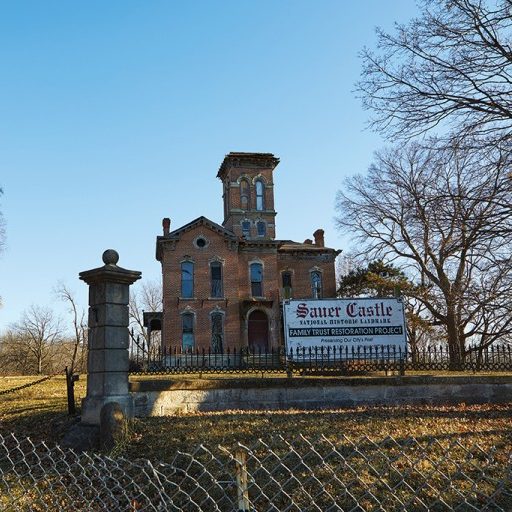
Sauer Castle
The word “castle” can often prove a little misleading. Sauer Castle, located in KCK’s Shawnee Heights neighborhood, looks like more of a home for the Addams family or Norman Bates than one for kings and queens. Finished in 1871, the large Italianate house was home to the Austrian-American Sauer family for several generations. The house currently sits unoccupied and in an unfortunate state of dilapidation, owing largely to frequent trespassing and vandalism.
Legends of grizzly tragedy and hauntings have plagued the house since the 1930s. These legends are not completely unwarranted. The house’s first owner died in the master bedroom, another owner took his own life in the house and a baby girl drowned in the pool on the property.
The original owner’s great-great-grandson, Carl Lopp, bought the house in the 1980s and has been trying to restore it ever since. Lopp resides in New York City and has received criticism over his alleged failure to adequately care for the historic landmark.
Caenen Castle
Situated peacefully on busy Johnson Drive in Shawnee, Caenen Castle most recently served as chef Renee Kelly’s self-named restaurant and event venue. Before that, the castle was home to the Caenen family, who lent their name to Caenen Street, which runs along the east side of the castle all the way down to southern Johnson County. Remi Caenen, a dairy farmer, built the castle from local stone that he quarried himself in 1907. In addition to being a family home and restaurant/venue, the castle has also served as a nursing home and even a nightclub.
Caenen Castle was sold at auction last year, and it remains unclear what the new owners have planned for the historic house’s future. The owner of the property is listed as a business under the name of Carladan Properties LLC, which has a Florida address.
Workhouse Castle
Just a few blocks from the 18th and Vine Jazz District, there is a ruined shell of a castle adorned with years of graffiti. The castle is known locally as the “city workhouse castle” and was originally a jail and workhouse for petty criminals. The castle was built in 1897 by the very inmates it was intended to house. It was a workhouse jail until 1924, after which it served several different purposes until it was finally closed and abandoned in 1972.
Plans were made in 2014 to renovate and revitalize the castle, but it doesn’t appear that any such plans have come to fruition.
Northland castle
Not all castles are old, dank and stuffy. In fact, sometimes they are relatively new, bright and luxurious, just like the one built on the Northland’s Weatherby Lake. It can even be yours… for a cool five-and-a-half million dollars.
The stately modern castle has been on the market for several months. According to the real estate listing, the home was built with stone that includes Carthage marble salvaged from a demolished historic home in Kansas City. The castle also boasts eighteen-foot ceilings, an elevator, custom fireplace mantels, murals and stained glass.
The statue of a sleeping child on the Plaza was mysteriously tucked in at night
A small child carved out of white marble sleeps peacefully on the median at the intersection of 47th and Broadway on the Plaza.
According to local legend, an older woman who lived in the neighborhood would cover the statue of the sleeping child with a blanket every winter. The occurrence was even documented in a Los Angeles Times article in 1988.
In 1994, a car struck and destroyed the original statue, and it was replaced the following year. But the blanket has not returned.
An associate at West Elm, which has a storefront facing the statue, said that he’s aware of the local legend, but he hasn’t seen a blanket on the statue for several years. It’s thought that the woman who used to cover the statue has since passed away.
A rumored mass grave of Civil War soldiers along Ward Parkway
If you’re ever strolling through KCMO’s Loose Park, you might spot a few historical markers commemorating the Battle of Westport, which took place at and around the park during the Civil War. One of these markers mentions the presence of a mass grave that was once located near 55th and Ward. Legends persist to this day that there are soldiers buried under the Ward Parkway median, but local history buff Daniel Smith disputes that there has ever been such a burial ground in that area.
Smith, who serves as the chairman of the Monnett Battle of Westport Fund, notes the existence of a burial ground at the southeast corner of 55th and State Line. This was a private cemetery used by the McCoy family, and the bodies were exhumed and relocated during J.C. Nichols’s development of the Country Club District in the early twentieth century.
“I am unaware of any reported mass burials,” Smith says. “One diary account at the time describes Wornall Lane as having dead soldiers scattered along the way over a distance from the present Loose Park to the Wornall House. There were instances of finding a dead soldier’s remains as late as 1882 along the side of present day Prospect (then Grandview Road).”
Smith explained that a more intriguing idea is that there may be some random burials of Civil War soldiers around the area done by local farmers at the time. As for the existence of any mass burial around the area of the park, it doesn’t appear to be backed by much historical evidence.
“Any mass grave would have resulted in a mass reinterment,” Smith says. “I am unaware of any other such mass interment.”
Shawnee Mission East’s Arsenic and Old Lace murder
My grandfather, Eldon Evans, ran the theater department at Shawnee Mission East High School in Prarie Village for several years in the 1960s and ’70s. When he first arrived at the school in 1968, he went through all the school yearbooks and newspapers to make a list of the shows that had been done since the school opened ten years earlier. He noticed that the fall play in 1959 had been inexplicably canceled.
“I went to some of the faculty who had been there at the time, and I asked why this play had been canceled,” he told me. “They explained to me it was because the school was putting on Arsenic and Old Lace, and a young lady involved with the production went home from rehearsal one evening and poisoned her parents.”
According to the Kansas City Times, fifteen-year-old Diane Roberts left rehearsal for the play about two spinsters who routinely poison old men with arsenic-laced wine on the evening of October 13, 1959. She returned to her home in idyllic Prairie Village, where she gave both of her parents grape juice laced with enough roach poison to kill eight people, telling them it was a “thrill powder.”
Kansas law at the time prevented children under the age of sixteen from being tried in criminal court, and it’s not clear what became of Roberts afterward. There is currently nobody under that name incarcerated or on the violent offender registry in the state of Kansas.
The horrors of Ogg Road in Shawnee Mission Park
For northwestern Johnson County teens, taking a stroll down Shawnee Mission Park’s Ogg Road after dark is a rite of passage. The nearly mile-long park road has a tragic and morbid history, including multiple documented suicides, and is said to be rife with paranormal activity.
Many claim to have heard disembodied footsteps and voices, captured seemingly unexplainable oddities in pictures and on video and audio recordings and experienced the sensation of being watched while strolling on Ogg Road after dark.
Bill Maasen, superintendent of parks and golf courses for Johnson County Parks and Recreation, told Kansas City that in his thirty-four years with the department, he has not heard of any supernatural activity on Ogg Road.
You can see the foundations of orphanage cabins in KCK
There is a rather unassuming apartment complex near the intersection of 43rd and Mission Road in an up-and-coming, increasingly trendy neighborhood in KCK. But only a select few Kansas City old-timers may remember what existed on that property before.
Between 1907 and 1981, it was a group home called Life Line Orphan Home, and it was home to children who were orphaned, unable to live with their families or juvenile offenders.
Despite being in operation for three quarters of a century in a well-populated part of town and housing probably thousands of children, the home has been all but forgotten. Even in the age of digital record-keeping, historical records and photographs are sparse. The facility closed its doors in 1981, and all of the children were relocated. All that remains of the former children’s home are a few concrete foundations of small buildings in the wooded area behind the apartment complex, as well as a charity bearing the Life Line name.
Terry Jacobsen, who has served as president of the board of Life Line for six years, explained what became of the old Mission Road orphanage.
“The liability of housing children in an orphanage is challenging, and the age and condition of the physical building became an issue, so they had to shut it down,” Jacobsen says.
The estate and its contents were sold off, and with that money, Life Line continues to operate as a charity organization that provides grants to organizations that benefit children and youth.
 ETHAN EVANS


Leave a comment